Carced News
VW Knew About A Steering Rack Bolt That Could Snap For Two Years Before Recalling 200,000+ SUVs
A single corroding bolt could let a steering rack hang on by one remaining fastener. VW knew about it in October 2024. The recall only just arrived.

A Two-Year Gap Between Discovery And Recall Deserves More Scrutiny Than It’s Getting
Safety recalls happen constantly, and most fade from the news cycle within a news cycle. This VW steering rack recall deserves a closer look specifically because of the timeline: VW says it first learned about this problem in October 2024. The recall is only landing now, roughly two years later — and for a defect this genuinely serious, that gap is worth sitting with.
The Failure Mode Is About As Bad As Recalls Get
If the right-hand steering rack mounting bolt corrodes enough to snap, the entire rack is left hanging onto the subframe by a single remaining bolt. Under enough load, VW says the whole rack could fracture — meaning a genuine, complete loss of directional control. That’s not a rattle or a warning light scenario; that’s the kind of failure mode that sits at the very top of what makes a recall urgent rather than routine.
208,724 Vehicles Across Three Nameplates
The 2018 Tiguan carries the largest share at 85,713 units, followed by 82,601 examples of the 2018-19 Atlas, and 40,410 units of the 2019-21 Audi Q3. That’s a genuinely wide footprint across VW Group’s US lineup, spanning both the VW and Audi badges and multiple model years — this isn’t a narrow production-batch issue, it’s a design-level vulnerability that touched a meaningful slice of VW’s compact and midsize SUV sales during this window.
There Is One Small Mercy In The Mechanism
VW says the bolt is more likely to fail at parking speeds, when steering load is highest, rather than at freeway speeds — which the company seems to be offering as some reassurance. I’d take that with real caution rather than comfort: a steering failure at low speed in a parking lot is still dangerous, especially with pedestrians nearby, and “more likely at low speed” doesn’t mean “impossible at highway speed.”
The Warning Signs Are Worth Memorizing If You Own One Of These
VW says drivers might notice an unusual rattling or knocking sound from the front axle before the rack actually departs. If you own a 2018 Tiguan, 2018-19 Atlas, or 2019-21 Audi Q3 and you’ve heard anything like that from the front end recently, this recall gives you a very specific reason to get it checked immediately rather than writing it off as a minor annoyance.
The Fix Itself Is Straightforward
VW is replacing the right-hand steering rack bolt on all 208,724 affected vehicles, regardless of whether they’ve shown symptoms, with a new bolt carrying a stronger corrosion-resistant coating. That’s a sensible, comprehensive remedy — but it doesn’t change the fact that this specific corrosion vulnerability sat unaddressed in the field for roughly two years after VW first became aware of it.
My Take
I don’t think VW is uniquely negligent here — investigation-to-recall timelines can genuinely take time for legitimate engineering and regulatory reasons. But a two-year gap on a defect capable of causing total loss of steering control is exactly the kind of case that deserves more public accountability about what happened during that window, not less. If you own one of these three models from these model years, don’t wait for the mailed notice — check with your dealer now, especially if you’ve heard any unusual noise from the front end.
Have you noticed any rattling or knocking from the front axle on a Tiguan, Atlas, or Q3 from these model years? Worth flagging in the comments so other owners know what to listen for.
More Carced news

You Can Buy HWA's $760K New 190E Evo II, Or The Real Thing For Less — And That's A Genuinely Hard Choice
A restomod exists to solve the problem of an original being too rare, too fragile, or too expensive to actually use. This time, the original might be the cheaper option.
Read article
Genesis Just Patented The G90 Coupe And Convertible, And That's More Than Just Paperwork
A design patent isn't a production announcement, but Genesis wouldn't bother protecting a design it had no intention of ever building — and having seen the Convertible in person, I understand why they'd want to.
Read article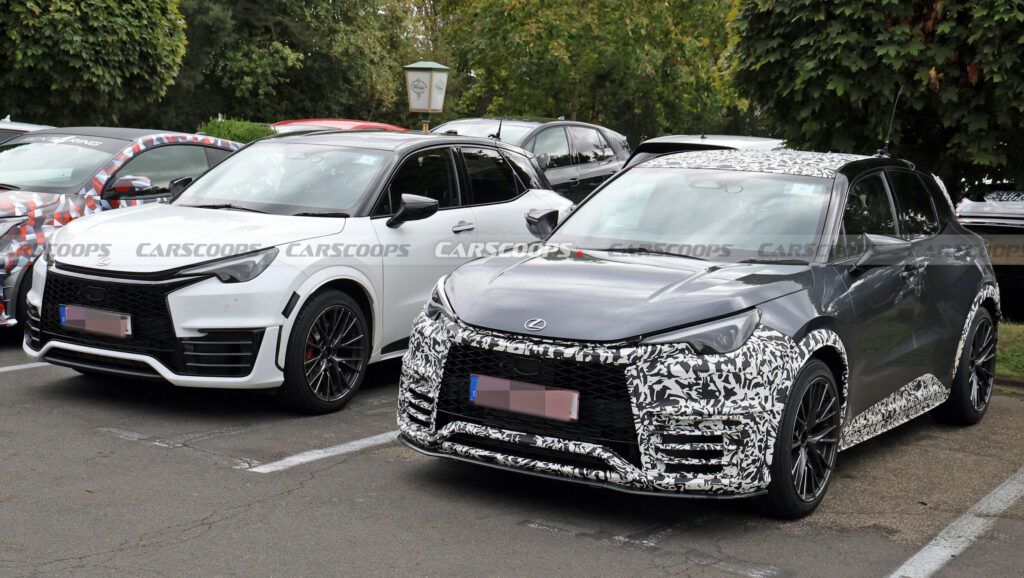
Lexus Is Building An Even Hotter LBX, And Carbon Fiber Is Doing All The Talking
The existing LBX Morizo RR already had a manual gearbox and GR-derived power. This new version's whole mission is shedding weight, and it's doing it with carbon fiber almost everywhere.
Read article
VW Wants $149 A Year To Turn Your Parked Car Into A Game Console, And I'm Weirdly Okay With It
Yet another automotive subscription fee sounds exhausting on principle. But this one is actually solving a real, specific dead-time problem — and it's bundled with features people already pay for anyway.
Read article