Carced News
Opel Is Building A New Wagon Concept, And Americans Won't Get Anywhere Near It
Europe gets a genuine new wagon concept with real production intent behind it. America, as usual, gets nothing — and honestly, the reasoning behind that split makes sense this time.
America Still Doesn’t Get Wagons, But At Least The Reason Makes Sense This Time
There’s a familiar disappointment in seeing “new wagon concept” and “not coming to America” in the same headline, but Opel’s Sports Tourer eXperimental (STX) Concept is worth paying attention to anyway — both for what it says about Europe’s continued commitment to the wagon body style, and for what it hints about the next-generation Astra.
Opel Has Genuine Wagon Heritage To Draw On
The company has been building family-friendly estates since the 1953 Olympia Rekord Caravan, and the Sports Tourer name already covers the current Astra’s wagon variant. That’s a genuinely deep well of heritage to pull design inspiration from, and it’s a meaningfully different starting point than a manufacturer inventing wagon credibility from scratch for a single concept.
CEO Florian Huettl’s Framing Signals Real Production Intent
Describing the STX Concept as representing “the future of an aero-efficient estate” and explicitly stating it previews “next generation design language and feature elements that you will see in future production models” is considerably more concrete language than typical concept-car marketing speak. Manufacturers don’t usually commit this directly to a concept previewing actual production direction unless there’s real internal alignment behind that roadmap.
The Astra’s Wagon Future Is Already Locked In
Stellantis has confirmed the next-generation Astra arrives before 2030, riding on the new STLA One architecture with both fully electric and hybrid powertrain options. Crucially, Huettl has also confirmed an estate variant of the next Astra is already committed — meaning the STX Concept isn’t just an abstract design exercise, it’s a genuine preview of a body style Opel has already greenlit for production.
The Hatchback’s Future Shape Is The More Intriguing Open Question
Huettl’s hint that the Astra hatchback’s shape “may evolve into a non-traditional bodystyle” is the more interesting subplot buried in this teaser. Reading between the lines, that suggests the next Astra could shift toward a sportier compact wagon-adjacent form factor rather than a conventional hatchback — which would make the STX Concept less a separate wagon variant and more a genuine preview of where the entire lineup’s silhouette is headed.
The Teaser Itself Is Deliberately Minimal
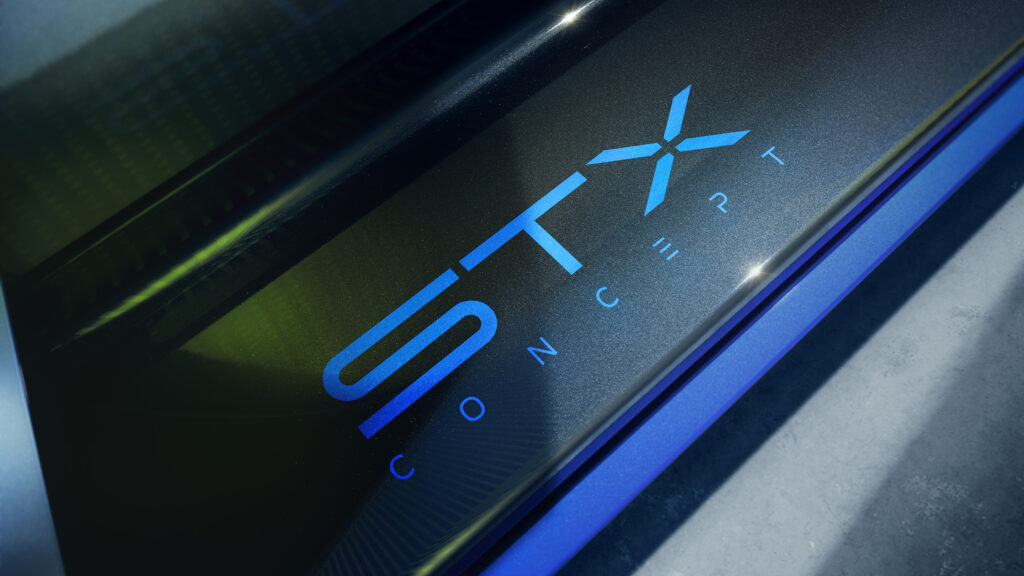
A single image showing STX lettering on what appears to be a carbon-style front bumper section, against blue or silver bodywork, doesn’t reveal much design detail yet. Opel hasn’t confirmed powertrain details either, though electrification of some kind is a safe assumption given the STLA One platform’s dual-powertrain capability.
This Fits Into A Broader October Push From Opel
The STX Concept won’t be alone at the Paris Motor Show — it’s joined by the GSE 27FE single-seater for Formula E, the fully electric Corsa GSE hot hatch, and the new Astra GSE Line trim. That’s a genuinely coordinated product push rather than an isolated concept reveal, suggesting Opel is using this moment to make a broader statement about its performance and design direction heading into the back half of the decade.
My Take
The “not coming to America” reality stings less than usual here because the reasoning is straightforward: American wagon demand has never recovered enough to justify the business case, while European buyers still genuinely support the body style. Rather than being frustrated about the availability gap, I’d rather focus on what’s actually interesting — Opel committing concretely to a wagon variant of its next Astra, and hinting the hatchback itself might evolve into something less conventional. That’s a more coherent product strategy than most European brands are currently showing for this segment.
If Opel (or any Stellantis brand) ever did bring a genuine wagon back to America, would there actually be enough demand to justify it, or has that ship permanently sailed here? I remain cautiously hopeful, probably against my better judgment.
More Carced news

You Can Buy HWA's $760K New 190E Evo II, Or The Real Thing For Less — And That's A Genuinely Hard Choice
A restomod exists to solve the problem of an original being too rare, too fragile, or too expensive to actually use. This time, the original might be the cheaper option.
Read article
Genesis Just Patented The G90 Coupe And Convertible, And That's More Than Just Paperwork
A design patent isn't a production announcement, but Genesis wouldn't bother protecting a design it had no intention of ever building — and having seen the Convertible in person, I understand why they'd want to.
Read article
Lexus Is Building An Even Hotter LBX, And Carbon Fiber Is Doing All The Talking
The existing LBX Morizo RR already had a manual gearbox and GR-derived power. This new version's whole mission is shedding weight, and it's doing it with carbon fiber almost everywhere.
Read article
VW Wants $149 A Year To Turn Your Parked Car Into A Game Console, And I'm Weirdly Okay With It
Yet another automotive subscription fee sounds exhausting on principle. But this one is actually solving a real, specific dead-time problem — and it's bundled with features people already pay for anyway.
Read article