Carced News
Kia's PV7 Van Makes Every Other Commercial Van Look Like It's Stuck In 2015
Commercial vans have always been the industry's most boring category by design. Kia's PV7 quietly makes the case that boring and cutting-edge aren't mutually exclusive.
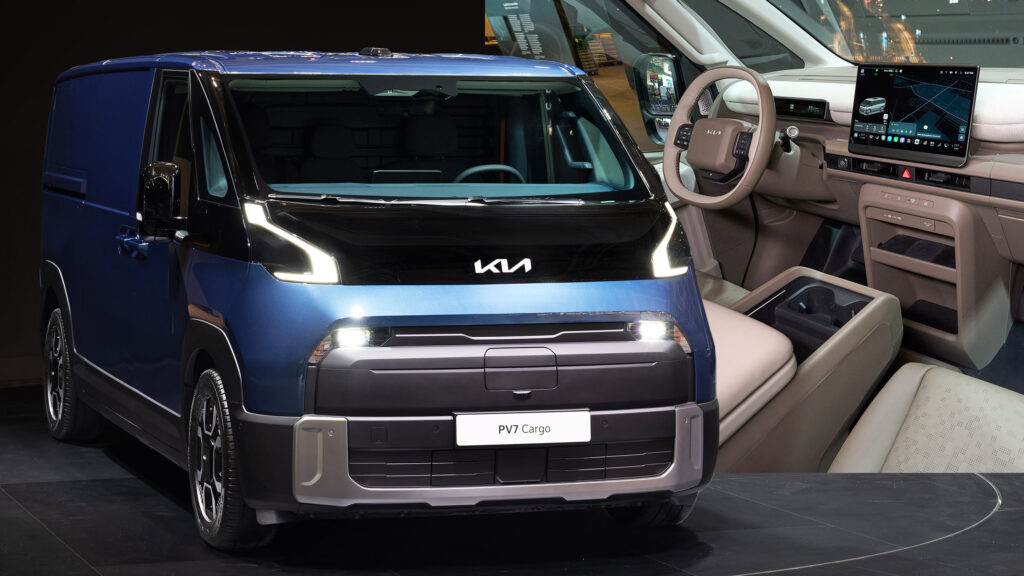
The Van Segment Just Got A Serious Wake-Up Call
Vans don’t usually get me excited. They’re the appliances of the automotive world — built to be reliable, cheap to run, and otherwise forgettable. Which is exactly why Kia’s new PV7, unveiled at IAA Transportation 2026, is worth a second look. This isn’t a van trying to be exciting for excitement’s sake. It’s a van that happens to be genuinely ahead of the curve on the stuff that actually matters to fleet buyers.
800 Volts Is The Number That Matters
The PV5, Kia’s smaller electric van, runs a 400-volt system. The PV7 jumps straight to 800 volts, and the payoff is a 10-80% charge in around 25 minutes on a 350 kW DC fast charger. For a vehicle whose entire value proposition is uptime — the fewer hours it spends charging, the more hours it spends earning — that’s not a nice-to-have spec. That’s the whole business case.
A Dashboard That Doesn’t Look Like An Afterthought
Commercial vehicle interiors have historically been an exercise in “good enough.” Kia clearly decided not to phone it in here: a 9.9-inch instrument cluster, a 14.6-inch touchscreen running Android-based Pleos Connect, ambient lighting, and the Gleo AI voice assistant. None of this is groundbreaking on its own, but seeing this level of polish in a van — a segment where buyers have historically tolerated mediocre tech because they had no other choice — feels like a real shift in what fleet operators are starting to expect.
23 Variants Is An Absurd Amount Of Flexibility
Cargo and Passenger configurations, Long and High Roof body styles eventually, three- to eleven-seat passenger layouts across three or four rows — Kia isn’t building one van and calling it done. It’s building a platform. The Cargo Long hits 215.4 cubic feet of volume, the Cargo High Roof scales to 282.5 cubic feet, and max payload lands at 1,200 kg for the Compact variant. That’s the kind of range that lets a single platform serve last-mile delivery, shuttle service, and everything in between without forcing buyers into a different vehicle for each job.
My Take
The PV7 isn’t a car you’ll see reviewed for its driving dynamics, and that’s fine — it’s not supposed to be. What matters here is that Kia applied genuinely current EV technology (800V architecture, fast DC charging, dual charging ports) to a segment that’s historically been slow to modernize. Sales start in Korea and Europe in the second half of 2027, and if the PV9 follows in 2029 as promised, Kia is building a real commercial EV lineup rather than a single halo product. That’s the kind of unglamorous, methodical strategy that actually wins fleet contracts.
Would an 800V architecture and sub-30-minute charging actually change your mind about electrifying a commercial fleet, or are there bigger barriers still in the way? Curious to hear from anyone running fleet vehicles.
More Carced news

You Can Buy HWA's $760K New 190E Evo II, Or The Real Thing For Less — And That's A Genuinely Hard Choice
A restomod exists to solve the problem of an original being too rare, too fragile, or too expensive to actually use. This time, the original might be the cheaper option.
Read article
Genesis Just Patented The G90 Coupe And Convertible, And That's More Than Just Paperwork
A design patent isn't a production announcement, but Genesis wouldn't bother protecting a design it had no intention of ever building — and having seen the Convertible in person, I understand why they'd want to.
Read article
Lexus Is Building An Even Hotter LBX, And Carbon Fiber Is Doing All The Talking
The existing LBX Morizo RR already had a manual gearbox and GR-derived power. This new version's whole mission is shedding weight, and it's doing it with carbon fiber almost everywhere.
Read article
VW Wants $149 A Year To Turn Your Parked Car Into A Game Console, And I'm Weirdly Okay With It
Yet another automotive subscription fee sounds exhausting on principle. But this one is actually solving a real, specific dead-time problem — and it's bundled with features people already pay for anyway.
Read article